
Introduction
If your home was built before 1980, there is a very real chance that the pipes running behind your walls, under your floors, and through your crawl space are made of galvanized steel. For decades, galvanized plumbing was the standard choice for residential water supply systems across the United States. It was considered durable, affordable, and far safer than the lead pipes it replaced.
But that was then.
Today, galvanized plumbing is widely recognized as one of the most common — and most costly — plumbing problems found in older homes. Understanding what galvanized plumbing is, how it works, why it fails, and what you should do about it can save you thousands of dollars, protect your family’s health, and help you make smarter decisions whether you are buying, selling, or simply living in an older home.
This complete guide covers everything you need to know about galvanized plumbing — from the science of how these pipes are made to the warning signs that yours may be failing.
What Is Galvanized Plumbing?
Galvanized plumbing refers to a water distribution system that uses galvanized steel pipes — steel pipes coated with a protective layer of zinc — to carry water into and throughout a building.
These pipes were the dominant choice for residential plumbing in the United States from roughly the 1930s through the late 1980s. If you live in a home built during that era and the plumbing has never been updated, you almost certainly have galvanized pipes somewhere in your system.
At the time of their widespread adoption, galvanized pipes represented a genuine improvement over what came before. They replaced older lead pipes, which posed serious health risks, and they offered a level of corrosion resistance that uncoated steel simply could not provide.
The fundamental problem with galvanized plumbing is not how it starts — it is how it ends. Over time, the zinc coating that protects galvanized pipe breaks down from the inside out. As it does, the pipe corrodes, accumulates rust and mineral deposits, restricts water flow, leaches metals into your drinking water, and eventually fails completely.
Understanding this degradation process is the key to understanding why galvanized plumbing is such an important topic for homeowners today.
What Does “Galvanized” Actually Mean?
The word galvanized comes from Luigi Galvani, an 18th-century Italian scientist whose work on electrical currents laid the groundwork for understanding how metals interact with each other electrochemically.
In modern usage, galvanizing refers to the process of applying a protective zinc coating to steel or iron to prevent rusting. Zinc serves as a sacrificial metal — meaning it corrodes preferentially in place of the underlying steel, protecting the base metal as long as the zinc coating remains intact.
You have probably seen galvanized metal in many forms:
- Galvanized roofing sheets
- Galvanized chain-link fencing
- Galvanized buckets and containers
- Galvanized nails and screws
- Galvanized steel plumbing pipe
In all of these applications, the principle is the same. The zinc coating acts as a barrier and a sacrificial layer, buying time for the underlying steel.
The critical word there is time. Zinc protection is not permanent. Eventually — especially in a water-carrying pipe where the zinc is constantly exposed to flowing water, dissolved minerals, oxygen, and varying pH levels — the coating breaks down. When it does, the steel beneath begins to rust, and the pipe begins its slow but inevitable decline.
History of Galvanized Plumbing in American Homes
To understand why so many homes still have galvanized plumbing, you need to understand the historical context in which these pipes became standard.
The Lead Pipe Era
Before galvanized steel became common, residential plumbing in the United States relied heavily on lead pipes. Lead was easy to work with, flexible, and corrosion-resistant. The word “plumbing” itself derives from plumbum, the Latin word for lead.
By the early 20th century, however, the health risks of lead were becoming increasingly understood. Lead dissolved into drinking water at levels capable of causing serious neurological damage, particularly in children. Communities and builders began searching for a safer alternative.
Galvanized Steel Steps In
Galvanized steel pipe emerged as the practical solution. It was:
- Affordable — steel was widely available and inexpensive to manufacture
- Strong — capable of handling the pressures of residential water systems
- Corrosion-resistant — the zinc coating provided meaningful protection against rust
- Lead-free — a significant health improvement over what it replaced
- Widely available — steel manufacturing infrastructure was already well established
Through the post-World War II housing boom of the late 1940s and 1950s, galvanized pipe became virtually ubiquitous in new residential construction. Millions of homes were built with galvanized supply lines during this era.
The Shift Away from Galvanized
By the 1960s and 1970s, copper pipe was becoming the preferred alternative. Copper offered superior corrosion resistance, did not accumulate internal deposits the way galvanized steel did, and was proven to maintain water quality over decades of use.
By the 1980s, most new residential construction had shifted entirely to copper. The use of galvanized pipe in new potable water systems was largely discontinued, and today it is not permitted under modern plumbing codes for new water supply installations.
This means that virtually every galvanized plumbing system still in service today is at least 40 years old — and many are significantly older. The pipes that were considered state-of-the-art in 1955 are now aging infrastructure approaching or well past the end of their functional service life.
How Galvanized Pipes Are Made
Understanding how galvanized pipe is manufactured helps explain both its initial strengths and its long-term vulnerabilities.
The Hot-Dip Galvanizing Process
The most common method used for galvanizing steel pipe is called hot-dip galvanizing. The process works as follows:
Step 1 — Surface Preparation
The steel pipe is thoroughly cleaned to remove all surface contaminants, mill scale, and oxidation. This typically involves degreasing, pickling in an acid bath, and fluxing.
Step 2 — Immersion in Molten Zinc
The cleaned steel pipe is submerged in a bath of molten zinc heated to approximately 840°F (449°C). The zinc bonds metallurgically with the steel surface, forming a series of zinc-iron alloy layers topped by an outer layer of pure zinc.
Step 3 — Withdrawal and Cooling
The pipe is withdrawn from the zinc bath and allowed to cool. The zinc solidifies into a tightly bonded coating that is typically 3.9 to 8.6 mils thick (depending on pipe grade and specification).
Step 4 — Threading and Inspection
The galvanized pipe is then threaded at each end using a pipe die, inspected for coating integrity, and bundled for distribution.
Pipe Standards and Grades
Galvanized steel pipe used in plumbing applications is manufactured to specific standards, most commonly ASTM A53, which covers both seamless and welded steel pipe. Pipe is available in various schedules (wall thicknesses), with Schedule 40 being the most common residential grade.
The pipe is produced in nominal sizes ranging from ⅛ inch to 6 inches or larger, with the most common residential sizes being ½ inch, ¾ inch, and 1 inch for supply lines.
Where Galvanized Pipes Are Used in a Home
Galvanized pipe was used in two primary applications in residential construction:
Water Supply Lines
This is the most common — and most problematic — application. Galvanized steel pipe was used to carry pressurized cold and hot water from the water meter or well to every fixture in the home: faucets, toilets, showers, bathtubs, washing machines, dishwashers, and water heaters.
These pressurized supply lines are where galvanized pipe causes the most significant problems. Because water is constantly flowing through them under pressure, internal corrosion and mineral accumulation directly impact water pressure, water quality, and pipe integrity.
Drain Lines
Galvanized pipe was also used in some older homes for drain-waste-vent (DWV) lines — the pipes that carry wastewater away from fixtures. However, cast iron was more commonly used for drain lines during the same era.
Galvanized drain pipes present a different set of problems than supply lines. Because they carry wastewater rather than pressurized clean water, the primary concern is structural failure and leakage rather than water quality.
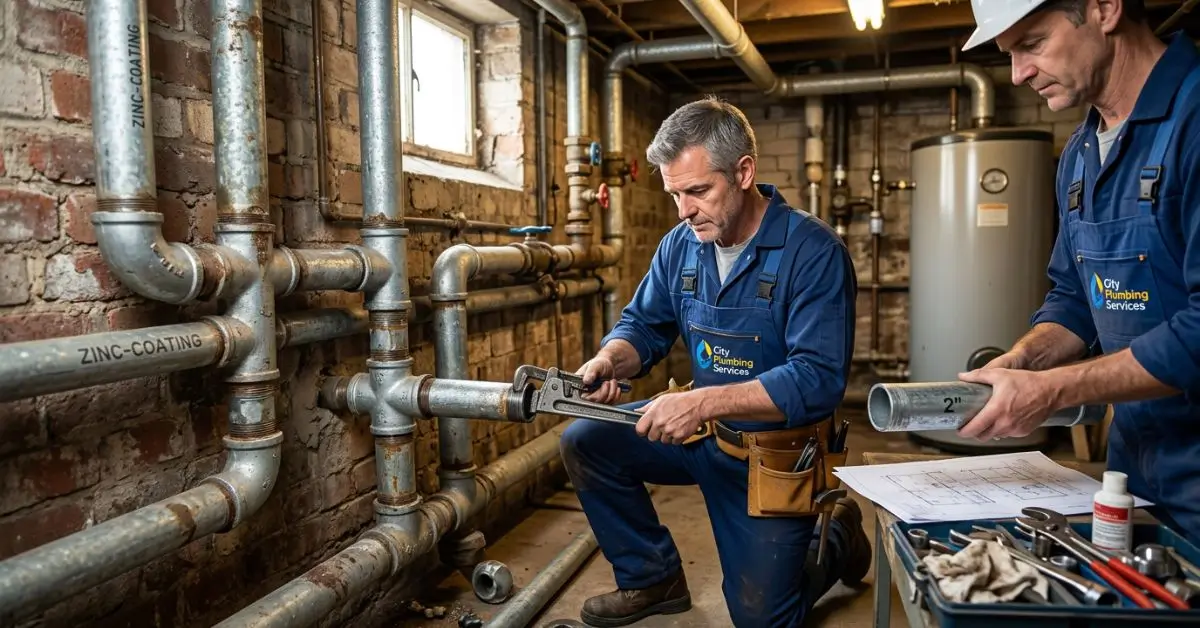
What Galvanized Pipe Looks Like
If you want to determine whether your home has galvanized plumbing, here is what to look for:
- Color: Dull gray or silver, sometimes with patches of rust or white powdery deposits
- Texture: Slightly rough surface with a crystalline or spangled pattern (visible as a subtle diamond-like texture on newer sections)
- Connections: Threaded fittings — the pipes screw into connectors rather than being soldered or crimped
- Magnetic response: A magnet will stick to galvanized steel pipe (unlike copper or plastic pipes)
- Scratch test: Scratching the surface of a galvanized pipe reveals a dull silver-gray metal beneath any surface oxidation
How Long Do Galvanized Pipes Last?
This is one of the most common questions homeowners ask — and the honest answer is that it depends on several factors.
General Lifespan Estimate
Under average conditions, galvanized steel pipe has an expected service life of 40 to 70 years. However, this range is broad for good reason. The actual lifespan of galvanized pipes in any given home depends on:
Water Chemistry
Water with high mineral content (hard water) accelerates internal scale buildup. Water with low pH (acidic water) attacks the zinc coating more aggressively. Water with high dissolved oxygen content accelerates corrosion throughout the pipe.
Water Source
Homes supplied by municipal water systems that use chlorination may experience faster zinc deterioration than homes on well water — though well water with high mineral content brings its own problems.
Pipe Diameter
Smaller diameter pipes (½ inch) restrict flow faster than larger pipes because the same amount of corrosion buildup represents a larger proportion of the usable interior diameter.
Installation Quality
Pipes installed with proper slope, support, and isolation from dissimilar metals tend to last longer than those installed carelessly.
Geographic Region
Regional soil chemistry, water quality, and climate all affect pipe longevity. Homes in regions with aggressive water chemistry may see pipes fail at 30 to 40 years. Homes with naturally neutral, low-mineral water may see pipes function adequately for 60 to 70 years.
What This Means Practically
If your home was built in 1955, your galvanized pipes are approximately 70 years old — at or well past the upper end of their expected service life.
If your home was built in 1975, your galvanized pipes are approximately 50 years old — within the expected lifespan range but approaching the point where failure becomes increasingly likely.
Even if your pipes have not shown obvious symptoms yet, their condition should be professionally assessed. Galvanized pipe failure is rarely sudden — it is a gradual process — but the consequences of a major failure can be severe.
Why Galvanized Pipes Fail Over Time
The failure of galvanized plumbing is not a manufacturing defect or a design flaw. It is an inevitable consequence of the chemistry involved. Understanding why galvanized pipes fail is essential to understanding the urgency of the problem.
Stage 1 — Zinc Depletion (Years 0–25)
In the early years, the zinc coating does its job effectively. It acts as a barrier between the water and the underlying steel, and it functions as a sacrificial anode — corroding preferentially to protect the steel.
During this stage, trace amounts of zinc dissolve into the water supply. This is generally not a health concern at the concentrations involved, and the pipe continues to function normally.
Stage 2 — Coating Breakdown and Early Corrosion (Years 20–40)
As the zinc coating thins and develops microscopic breaches, water begins to contact the underlying steel directly. Iron oxide — rust — begins to form on the interior pipe wall.
Simultaneously, minerals dissolved in the water (primarily calcium and magnesium) begin to precipitate and accumulate on the pipe interior, a process called scaling. These deposits combine with rust to form a rough, irregular surface on the pipe interior.
This is also the stage where tuberculation begins — the formation of mound-like rust nodules on the pipe’s interior surface. These nodules grow over time, progressively reducing the pipe’s effective interior diameter and restricting water flow.
Stage 3 — Progressive Restriction and Contamination (Years 30–50+)
By this stage, the process has accelerated significantly. The rough interior surface created by rust and scale attracts additional deposits. The pipe’s effective interior diameter may be reduced by 50 percent or more in severe cases — a pipe that started with a ¾-inch interior diameter may have an effective flow diameter of only ⅜ inch.
Water flowing through the restricted pipe dislodges rust particles and sediment, which appear in the water as discoloration, cloudiness, or visible particles. The metallic taste that homeowners in older homes sometimes report is often attributable to iron and zinc from corroding galvanized pipes.
Stage 4 — Structural Failure (Years 40–70+)
As corrosion continues, the pipe wall itself thins. The result is pinhole leaks, joints that fail under normal water pressure, and eventually complete pipe sections that rupture.
Water damage from failing galvanized pipes is one of the most common — and most expensive — homeowner insurance claims. A single burst pipe can cause tens of thousands of dollars in structural damage, mold remediation costs, and personal property loss.
Warning Signs of Failing Galvanized Plumbing
Galvanized pipe failure rarely happens without warning. The following symptoms are the most important to recognize:
Discolored Water
Brown, orange, or rust-colored water — particularly when you first turn on a faucet after the water has been sitting in the pipes — is one of the clearest indicators of galvanized pipe corrosion. The discoloration comes from iron oxide particles dislodged from the corroding pipe interior.
Low Water Pressure
If your water pressure has declined noticeably over the years, or if pressure is significantly lower than it once was, internal buildup in galvanized pipes is a likely culprit. The accumulated corrosion and scale physically reduce the pipe’s interior diameter, restricting flow.
Visible Corrosion at Pipe Joints
Inspect any exposed galvanized pipes in your basement, crawl space, utility room, or under sinks. White powdery deposits, orange rust staining around joints, or active moisture at connections are warning signs of deterioration.
Frequent Leaks
A single pipe leak in an older galvanized system is not just a repair problem — it is a warning that the entire system may be near the end of its service life. If you have repaired two or more galvanized pipe leaks in recent years, the system likely needs comprehensive evaluation and replacement.
Metallic or Unpleasant Taste
A metallic taste in tap water, particularly from the cold water supply (which is more directly affected by pipe chemistry than water that has been heated), can indicate elevated iron or zinc levels from corroding galvanized pipe.
Water Stains in Fixtures
Persistent rust-colored staining in bathtubs, sinks, or toilet tanks — despite regular cleaning — often indicates iron particles in the water supply from corroding galvanized pipes.
Health Risks Associated with Galvanized Pipes
This is an area where many homeowners have genuine and justified concerns — and where accurate information is especially important.
Iron and Zinc
The most common contaminants from corroding galvanized pipes are iron (from the steel base) and zinc (from the protective coating). At the levels typically found in homes with corroding galvanized pipes, neither iron nor zinc poses an acute health threat. However, elevated iron levels can cause gastrointestinal discomfort, and the discoloration and taste they produce make the water unpleasant to use.
Lead — A More Serious Concern
This is where the health picture becomes significantly more serious. While galvanized pipes themselves do not contain lead, they present a lead exposure risk through two mechanisms:
First, older homes that had galvanized pipes installed also frequently had lead solder used at connections. As the galvanized system corrodes, it can dislodge and mobilize lead from these joints.
Second, galvanized steel pipes can adsorb lead from upstream lead service lines — the pipes that run from the water main to the home. Studies have shown that galvanized pipes in contact with lead service lines accumulate lead within their corrosion layers and then slowly release it into the water supply, even after lead service lines have been removed.
The EPA’s Lead and Copper Rule and its 2021 revisions (the Lead and Copper Rule Revisions, or LCRR) specifically acknowledge galvanized pipes as a lead exposure concern precisely because of this mechanism.
If your home has galvanized plumbing — particularly if it was built before 1960 — having your water tested for lead by a certified laboratory is a prudent and important step.
Legionella
Corroded galvanized pipes can harbor Legionella bacteria in the biofilms and sediment that accumulate in their deteriorated interiors. While Legionella is more commonly associated with large building water systems, severely corroded residential galvanized pipes are not immune to this risk.
Galvanized Plumbing and Your Home’s Value
Galvanized plumbing has measurable implications for your home’s financial value and marketability — implications that every homeowner should understand.
Home Inspection Findings
Every competent home inspector will identify galvanized plumbing and note it in their inspection report. Depending on the apparent condition of the pipes, inspectors may characterize galvanized plumbing as anything from a deferred maintenance item to a significant deficiency requiring immediate attention.
Buyers who receive an inspection report noting galvanized plumbing will typically respond in one of three ways: requesting a price reduction, requiring the seller to repipe before closing, or — in cases where multiple major issues are identified — walking away from the purchase.
Insurance Implications
Many homeowners insurance carriers are increasingly cautious about homes with galvanized plumbing. Some carriers:
- Charge higher premiums for homes with galvanized pipes
- Exclude water damage resulting from “gradual deterioration” of galvanized pipes
- Require repiping as a condition of coverage
- Deny claims for water damage attributed to galvanized pipe failure on the grounds that the failure was foreseeable
Understanding your policy’s specific language regarding pipe materials is essential if your home has galvanized plumbing.
Mortgage Financing
FHA and VA loan programs have specific property condition requirements. Severely deteriorated galvanized plumbing that is actively leaking or causing visible damage may cause a home to fail FHA or VA appraisal, complicating or preventing the sale.
Even with conventional financing, an appraiser who notes significantly deteriorated galvanized plumbing may adjust the property’s value downward to reflect the cost of necessary remediation.
Conclusion
Galvanized plumbing was a genuine advance in its time — a safer, more durable alternative to the lead pipes it replaced. But every plumbing material has a lifespan, and galvanized steel pipe’s useful service life is measured in decades, not centuries.
If you live in an older home, understanding your plumbing system is not optional — it is essential to protecting your family’s health, your home’s value, and your financial well-being. The good news is that modern replacement options are better than ever. PEX and copper repiping can restore full water pressure, eliminate water quality concerns, and provide another 50 or more years of reliable service.
Frequently Asked Questions
Is galvanized plumbing dangerous?
Not immediately, but old galvanized pipes can cause lead exposure, poor water quality, leaks, and water damage over time.
Can galvanized pipes be used in new homes?
No. Modern plumbing codes no longer allow galvanized steel pipes for new potable water systems.
How can I identify galvanized pipes?
They are dull gray, rough-textured metal pipes with threaded joints, and magnets stick to them.
Does a 1965 home always have galvanized pipes?
Not always. Many homes from that era used galvanized pipes, but some used copper instead.
Should I replace galvanized pipes before selling?
Replacing them can improve buyer confidence and home value, but costs may not always be fully recovered.