
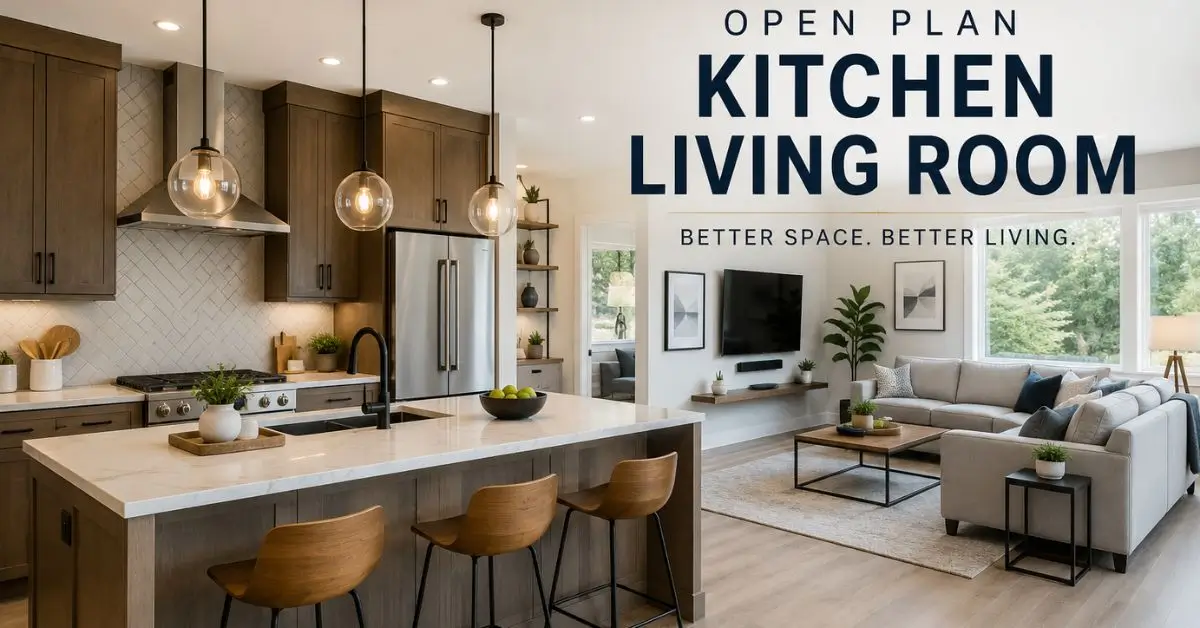

Open Plan Kitchen Living Room
You walk into a home and the kitchen, dining area, and living room all flow together — no walls cutting things off, no narrow doorways, just one connected space. It feels bigger, brighter, and more social. That’s what an open plan kitchen living room looks like in practice. More homeowners across the US, UK, and Canada are choosing this layout. But is it always the right move?
What is an open plan kitchen living room? It’s a home layout where the kitchen and living room share one continuous space without a full dividing wall between them. The areas may be visually separated by furniture, flooring, or a kitchen island, but they remain part of the same open room.
This guide covers everything the real benefits, the honest downsides, design tips that actually work, and the key questions you should answer before making any decisions.
Quick Summary
An open plan kitchen living room removes walls to create one shared space. It makes homes feel bigger, supports family connection, and works well for entertaining. But it also comes with noise, smell, and privacy challenges. This guide helps you decide if it’s right for your home and how to design it well.
Why So Many Homeowners Are Going Open Plan
The shift toward open layouts isn’t new, but it’s grown significantly over the past 20 years. In the US especially, the open concept home became the standard in new builds through the 2000s and 2010s.
A few reasons explain the popularity:
Families want to stay connected. A parent cooking dinner can still see the kids doing homework in the living area. There’s no wall separating people just because they’re doing different things.
Smaller homes feel larger. Removing a wall between a kitchen and living room can make a modest-sized house feel noticeably more spacious. Natural light travels further. Sightlines are longer. The effect is real, not just decorative.
It supports how people actually live. Most social gatherings end up in the kitchen anyway. An open layout acknowledges that and gives everyone space to be together naturally.
In a typical American suburban home — say, a 1,800 sq ft house built in the 1990s with a closed-off kitchen — removing the wall between the kitchen and living room is one of the most common and impactful renovations homeowners pursue. Real estate agents in many US markets also report that open layouts help homes sell faster and sometimes at higher prices.
The Real Benefits of an Open Plan Kitchen Living Room
Let’s be specific here. The benefits are real, but they work differently depending on your household.
More usable space. Two smaller rooms become one larger, more flexible room. You’re not wasting square footage on walls and doorways.
Better natural light. Windows in the living area can now light the kitchen too. This is a significant quality-of-life improvement, especially in homes where the kitchen was originally tucked away with minimal windows.
Easier supervision. For families with young children, being able to cook while keeping an eye on the living area is a genuine practical benefit, not just a lifestyle trend.
Stronger social flow. Hosting guests becomes less isolating. You’re part of the conversation while you’re cooking, not stuck in a separate room.
Flexible furniture arrangements. One large space gives you more options. You can define zones with rugs, sofas, kitchen islands, or lighting rather than being locked into a fixed room layout.
The Honest Downsides You Should Know
This is where a lot of design content goes wrong. They list the benefits and skip the real challenges. Here’s an honest look at what can go wrong.
Cooking smells spread everywhere. This is one of the most common complaints from people who switch to an open layout. A strong extraction fan helps significantly, but it doesn’t eliminate the issue entirely. If you cook with strong spices regularly, this matters.
Noise carries across the space. Kitchen appliances — blenders, dishwashers, extractor fans — are louder in an open space. Someone watching television in the living area and someone using the kitchen at the same time creates real noise conflict.
Clutter is always visible. In a closed kitchen, you can shut the door on a messy counter. In an open plan space, the kitchen is on display at all times. This suits tidy people well. For others, it adds low-level daily stress.
Heating and cooling is harder. One large open space can be harder to heat efficiently than two smaller rooms. In colder US states or Canada, this can lead to noticeably higher energy bills.
Less privacy. If someone wants to sit quietly in the living area while another person cooks, the separation just isn’t there. This is a real consideration for households where people have different schedules or routines.
None of these are dealbreakers for everyone. But knowing them upfront helps you make a smarter decision.
Key Design Principles That Make It Work
If you decide an open plan kitchen living room is right for your home, good design makes a huge difference. Here are the principles that experienced interior designers return to repeatedly.
Define zones clearly without walls. The most successful open plan spaces feel intentional, not chaotic. Use a large kitchen island to mark where the kitchen ends. Use a rug to anchor the living area. Use pendant lighting over the dining table to give it its own identity. Visual separation creates the feeling of different spaces without physical barriers.
Match your materials and finishes. Because everything is visible at once, clashing styles look worse in an open layout than they do in separate rooms. The kitchen cabinetry color, the sofa, the flooring — these need to feel like they belong together. You don’t need to match everything exactly, but they should work within the same palette.
Invest in a proper extraction system. If there’s one place to spend money in an open plan kitchen living room, it’s ventilation. A high-quality range hood that vents outside — not one that recirculates air — dramatically reduces cooking odors spreading into the living space.
Think carefully about kitchen placement. If you’re designing from scratch or doing a major renovation, consider where the kitchen sits within the open space. Placing it at the far end, rather than directly beside the sofa, reduces noise and smell impact on the living area.
Use consistent flooring or smart transitions. Some homeowners use the same flooring throughout to emphasize the open feel. Others use different flooring materials to gently separate zones. Both approaches work. What doesn’t work well is abrupt, awkward transitions that look unplanned.
Control the acoustics. Rugs, upholstered furniture, curtains, and soft furnishings all absorb sound. In a large open space with hard floors and minimal soft materials, the room can feel echoey and noisy. Layering textures helps.
Is an Open Plan Kitchen Living Room Right for Your Home?
This depends on your household more than on design trends.
Good fit if:
- You have children and want to supervise while cooking
- You entertain guests regularly
- Your home is smaller and you want it to feel more spacious
- You don’t mind keeping the kitchen visible and tidy
- You cook without heavy odors most of the time
May not suit you if:
- Multiple people are home with different noise needs
- You cook regularly with strong-smelling ingredients
- You value separate, quiet spaces
- Your home has limited windows and the kitchen would still be dark
- You’re in a colder climate with high heating costs
It’s also worth noting that the open plan trend, while still popular, has seen some pushback in recent years. Some homeowners who removed walls are now adding partial walls or large room dividers back in — not to fully separate rooms, but to bring back some acoustic and visual separation.
A Simple Comparison: Open Plan vs. Closed Kitchen
| Factor | Open Plan Kitchen Living Room | Closed Kitchen Layout |
|---|---|---|
| Space feel | Larger, more connected | Smaller but more defined |
| Natural light | Travels across both areas | Limited to kitchen windows |
| Noise | Spreads between areas | Contained in kitchen |
| Cooking smells | Spread throughout space | Mostly contained |
| Privacy | Lower | Higher |
| Supervision of kids | Easy | More difficult |
| Clutter visibility | Always visible | Can be hidden |
| Heating efficiency | Can be harder | Easier to manage |
Conclusion
An open plan kitchen living room works extremely well for the right household. The benefits — connection, light, flexibility, and a sense of space — are genuine. So are the challenges around noise, smells, and privacy.
The most useful thing you can do before committing is spend time in an open plan home that belongs to someone who actually lives there day-to-day. Not a showroom. Not a staged listing. A real lived-in home. The experience will tell you more than any guide can.
If you decide to move forward, focus on the basics: good ventilation, thoughtful zone definition, and consistent design choices throughout the space. These things matter far more than which cabinet handles you pick.
Frequently Asked Questions
Does an open plan kitchen living room add value to your home?
Yes, in most US markets it does. Open layouts attract more buyers and can boost sale price — but only when the renovation is done well. A poorly executed open space can be neutral or even hurt value.
What does it cost to open a kitchen into the living room?
Most homeowners in the US spend between $3,000 and $15,000. The biggest factor is whether the wall is load-bearing. Always get a structural engineer to check before you touch anything — what looks like a simple wall may be carrying real weight above it.
How do you separate the two areas without a wall?
Use a kitchen island, a large rug, pendant lighting, or a change in flooring. Positioning your sofa with its back to the kitchen also creates a natural divide. Two or three of these methods together work better than one alone.
Is open plan living going out of style?
Not exactly — but it’s evolving. Many homeowners now want some separation back, without fully closing rooms off. “Broken plan” design, which uses partial walls or level changes, is growing in popularity in both the US and UK.
What size space do you need?
At least 300–400 square feet combined works best. The key is making sure each zone — kitchen, dining, and living — has enough room to function comfortably on its own.