
Bathroom Faucet Parts
A dripping faucet keeps you up at night. Low water pressure makes washing your hands frustrating. A handle that spins without stopping the flow suggests a worn-out internal component. These problems all have solutions, but finding the right solution starts with knowing what part is causing the problem.
Most homeowners can identify a faucet handle and an aerator. Beyond that, the internal anatomy of a bathroom faucet is unfamiliar territory, which means trips to the hardware store with no clear idea of what to ask for, or calls to a plumber for repairs that a knowledgeable homeowner could handle themselves.
This guide names and explains every major bathroom faucet part, describes what it does, and tells you what symptoms indicate when each part has failed. By the end, you will know exactly what you are looking for when something goes wrong.
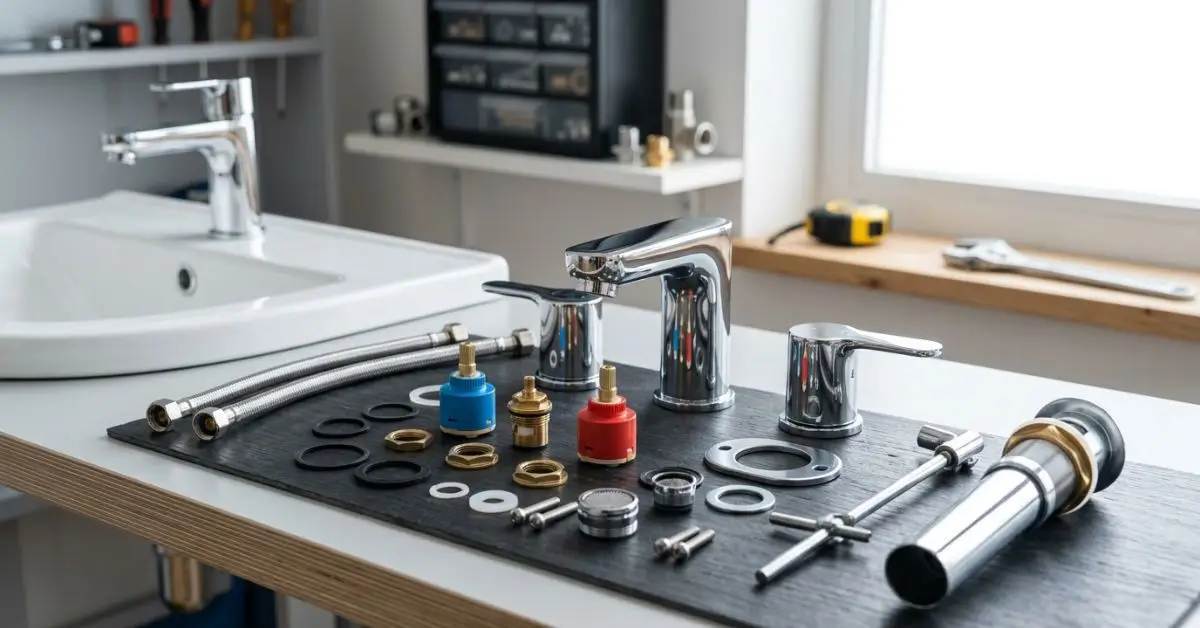
Bathroom faucet parts are the individual components that make up a complete faucet assembly, including external elements like handles, spouts, and aerators, and internal components like cartridges, valves, O-rings, and valve seats. Each part serves a specific function in controlling water flow, temperature, and pressure. When any component wears out or fails, it causes specific and identifiable symptoms that point to which part needs attention.
Quick Summary
Every bathroom faucet contains a set of standard parts that control water flow, temperature, and pressure. The most commonly replaced parts are cartridges, O-rings, valve seats, and aerators. Identifying which part has failed based on your specific symptom saves time and money. This guide covers every major part, what it does, and what its failure looks like.
Why Understanding Faucet Anatomy Matters
A bathroom faucet that drips wastes more water than most homeowners realize. A faucet dripping once per second wastes over 3,000 gallons of water per year according to EPA estimates. That is both an environmental and a financial problem that compounds quietly over months before most people address it.
Beyond water waste, a faucet with a failing internal component usually gets worse before the homeowner acts on it. A worn O-ring causes a minor drip that becomes a leak. A failing cartridge causes a leak that eventually damages the cabinet beneath the sink. Early identification and repair of failing parts prevents the minor problem from becoming a major one.
The barrier for most homeowners is not willingness to fix things. It is not knowing what they are looking at when they open up a faucet. This guide removes that barrier.
The Main Types of Bathroom Faucets and How They Affect Parts
Before covering individual parts, understanding that bathroom faucets come in different valve types matters because the internal parts vary significantly between types.
Ball faucets use a rotating ball mechanism to control flow and temperature. They are common in single-handle configurations and use springs, seats, and a ball as their core internal components.
Cartridge faucets use a replaceable cartridge that moves up and down to control flow and rotates to control temperature. These are among the most common types in modern bathrooms and are relatively straightforward to repair.
Ceramic disc faucets use two ceramic discs that slide past each other to control flow. They are highly durable and require less maintenance than other types, though the discs do occasionally need cleaning or replacement.
Compression faucets are the oldest type, using a rubber washer pressed against a seat to stop water flow. These are common in older homes and require regular washer replacement as the rubber wears with use.
Knowing which type you have before shopping for parts is essential because a cartridge for a Delta faucet will not fit a Moen, and a ball valve assembly will not help a compression faucet problem.
Every Major Bathroom Faucet Part Explained
The Handle
The handle is what you touch every time you use the faucet. It translates your hand movement into mechanical action inside the faucet body. Single-handle faucets use one handle to control both flow and temperature. Double-handle faucets use separate handles for hot and cold.
Handles rarely fail mechanically but do become loose over time as the set screw that holds them to the stem wears or strips. A handle that spins freely without controlling water flow has a stripped set screw, a worn stem connection, or both.
The Handle Screw and Decorative Cap
Most faucet handles have a small decorative cap on top that conceals the set screw beneath. Prying off this cap reveals the screw that holds the handle to the stem. Handles cannot be removed for internal access without removing this screw first. It is a small detail but a common source of confusion for first-time DIY faucet repairs.
The Packing Nut
Located beneath the handle, the packing nut holds the stem or cartridge in place within the faucet body. Tightening a loose packing nut often stops a leak around the base of the handle without requiring part replacement. It is the first thing worth checking when water appears around the handle base.
The Cartridge
The cartridge is the core functional component in cartridge-type faucets. It is a self-contained unit that moves to control both water flow volume and temperature. When a cartridge fails, the most common symptoms are a faucet that drips constantly, a handle that moves stiffly, or a loss of the ability to control hot and cold water separately.
Cartridges are brand and model specific. A Moen 1225 cartridge will not work in a Kohler faucet. Before purchasing a replacement, note your faucet brand and look up the specific cartridge model number for your faucet, which is typically available on the manufacturer’s website using the faucet model number.
The O-Rings
O-rings are small rubber rings that sit around stems and cartridges to create watertight seals at connection points. They are among the most commonly replaced bathroom faucet parts because rubber degrades with heat, water exposure, and mineral contact over time.
The classic symptom of a failed O-ring is a leak around the base of the spout or around the handle. The leak appears around the outside of the faucet rather than dripping from the spout tip, which distinguishes an O-ring failure from a cartridge or valve seat failure.
O-rings are inexpensive, typically under a dollar each, and replacing them is among the simplest faucet repairs available to a confident DIYer.
The Valve Seat
The valve seat is the connection point between the faucet and the spout. In compression faucets, it is the surface that the rubber washer presses against to stop water flow. Over time, mineral deposits and sediment accumulate on the valve seat, creating an uneven surface that prevents the washer from sealing completely.
A rough or corroded valve seat is one of the most common causes of a persistently dripping faucet in older homes. Valve seat replacement or resurfacing with a seat grinder tool addresses this. If the seat is damaged beyond resurfacing, the entire faucet body may need replacement.
The Stem
The stem connects the handle to the internal valve mechanism. In compression faucets, the stem moves up and down to press the washer against the seat. In cartridge faucets, the cartridge performs this function instead.
Stems in compression faucets have a rubber washer at their base that is the most commonly replaced part in this faucet type. When the washer wears down, the faucet drips from the spout tip. Replacing the washer, a job that costs under a dollar in parts and takes about fifteen minutes, stops the drip.
The Springs and Seats (Ball Faucets)
Ball-type faucets use small springs and rubber seats inside the faucet body beneath the ball. These springs press the seats against the ball to create a seal. When springs weaken or seats wear, the faucet drips from the spout. Ball faucet repair kits typically include replacement springs, seats, the ball itself, and all necessary O-rings for a complete internal overhaul.
The Ceramic Discs
In ceramic disc faucets, two ceramic discs, one stationary and one that rotates, slide against each other to control water flow. Ceramic is extremely hard and long-lasting, but mineral deposits can accumulate on disc surfaces and cause leaks or stiff handle movement.
Cleaning ceramic discs with white vinegar often resolves mineral buildup issues without requiring replacement. If the disc is cracked or chipped, replacement is necessary. Ceramic disc cartridge assemblies are available as complete replacement units from most faucet manufacturers.
The Aerator
The aerator is the small screen assembly at the tip of the faucet spout. It mixes air into the water stream to create a smooth, consistent flow and reduces splashing. Over time, mineral deposits and debris clog the aerator screen, reducing flow and causing uneven spray patterns.
Unscrewing the aerator by hand or with pliers wrapped in a cloth, soaking it in white vinegar for thirty minutes, and reinstalling it restores flow in most cases. If the aerator is corroded beyond cleaning, replacement aerators cost $5 to $15 and install in minutes.
The aerator is the first thing worth checking when you notice reduced water pressure from a bathroom faucet. Most pressure issues that affect only one faucet are caused by a clogged aerator rather than a plumbing problem.
The Supply Lines
Supply lines are the flexible hoses that connect the shut-off valves under the sink to the faucet. They come in braided stainless steel or reinforced rubber and carry hot and cold water separately to the faucet body.
Supply lines do not typically fail in normal use but should be replaced when a faucet is changed or if they show any sign of corrosion, kinking, or moisture around the connections. Braided stainless steel supply lines are more durable than rubber and worth the small additional cost.
The Shut-Off Valves
Shut-off valves are located under the sink on the water supply lines. They allow you to stop water flow to the faucet for repairs without turning off the main water supply to the home. Most modern shut-off valves are quarter-turn ball valves. Older homes may have compression-type valves that can develop leaks over time.
If your shut-off valve leaks or will not fully close, it should be replaced before attempting any faucet repair. A valve that leaks or cannot fully stop water flow makes any faucet repair significantly more complicated.
Quick Reference: Bathroom Faucet Parts and Their Common Problems
| Part | Function | Common Failure Symptom |
|---|---|---|
| Handle | Controls flow and temperature | Loose, spins freely, or is hard to turn |
| Cartridge | Regulates water flow and mix | Dripping spout, stiff handle, temperature issues |
| O-ring | Seals stem and cartridge connections | Leak around handle base or spout base |
| Valve seat | Seals point between valve and spout | Persistent drip from spout tip |
| Rubber washer | Compression seal in stem faucets | Drip from spout tip when faucet is off |
| Springs and seats | Ball faucet internal seals | Drip from spout in ball-type faucets |
| Aerator | Smooths and aerates water flow | Reduced pressure, uneven spray, splashing |
| Supply lines | Carry water from valves to faucet | Visible corrosion or moisture at connections |
| Shut-off valve | Stops water flow for repairs | Leaks or cannot fully stop wate |
When to Replace Parts Versus the Whole Faucet
Replacing individual parts makes sense when the faucet is relatively new, the faucet body is in good condition, and replacement parts are readily available and reasonably priced.
Replacing the entire faucet makes more sense when the faucet is more than fifteen to twenty years old, when multiple parts are failing simultaneously, when the faucet body is corroded or physically damaged, or when replacement parts are difficult to source because the model has been discontinued.
A homeowner in Seattle replaced the cartridge and O-rings in a twelve-year-old single-handle faucet for under $25 in parts and thirty minutes of work. The same repair on a thirty-year-old faucet with a corroded body and no available cartridge would have been better addressed with a complete faucet replacement.
Conclusion
Understanding your bathroom faucet parts transforms a confusing maintenance task into a manageable one. When you know what each component does and what its failure looks like, diagnosing a faucet problem becomes a process of elimination rather than a mystery.
Start with the symptom. Find it in the quick reference table. Identify the part most likely responsible. Order the correct replacement for your faucet brand and model. Most bathroom faucet repairs are genuinely achievable with basic tools, the right part, and this guide.
If you found this helpful, take a look at our related articles on how to replace a bathroom faucet cartridge and choosing the best bathroom faucets for hard water. Both give you the practical next steps for the most common faucet repair and replacement decisions homeowners face.
Frequently Asked Questions
What are the main parts of a bathroom faucet?
The main parts include the handle, cartridge or valve stem, O-rings, valve seat, aerator, supply lines, and shut-off valves. Internal components vary depending on whether the faucet is a cartridge, ball, ceramic disc, or compression type.
How do I identify which part needs replacing?
Match your symptom to the component. A spout drip points to a worn cartridge or valve seat. A leak around the handle base suggests O-ring failure. Reduced pressure usually means a clogged aerator.
How much does it cost to replace faucet parts?
Aerators cost $5 to $15. O-rings are under $1 each. Cartridges run $15 to $50. A ball faucet repair kit costs $10 to $25. Plumber labor adds $75 to $150 per hour if professional help is needed.
Can I replace faucet parts myself?
Yes, for most common repairs. Aerator cleaning, O-ring replacement, and cartridge swaps are straightforward DIY tasks. Valve seat work and failing shut-off valves are better left to a plumber.
Are faucet parts brand specific?
Internal parts like cartridges are almost always brand specific. Always confirm your faucet brand and model before buying. Aerators are more standardized and often interchangeable across brands.