
Sewer Line Replacement: Warning Signs, Methods, Costs, and What to Expect
Finding out your sewer line needs attention is one of the more stressful things a homeowner can hear. It is invisible, it is underground, and the repair costs can feel completely unpredictable if you do not know what you are dealing with.
The good news is that sewer line replacement is well understood, the methods have improved significantly over the past two decades, and knowing the key facts before you talk to a plumber puts you in a much stronger position to make a smart decision.
This guide covers everything a homeowner needs to know. What sewer line replacement actually means, what causes the need for it, the warning signs to watch for, the different replacement methods available today, realistic cost ranges, and honest guidance on when full replacement is necessary versus when a repair will do the job.
Sewer line replacement is the process of removing and installing new pipe in the main sewer line that runs from a home’s plumbing system to the municipal sewer connection or septic tank. It becomes necessary when a pipe is too damaged, deteriorated, or compromised to function reliably through repair alone. Methods range from full excavation to minimally invasive trenchless techniques depending on pipe condition and location.
Quick Summary
Sewer line replacement involves removing damaged main drain pipe and installing new pipe between your home and the sewer connection. It is caused by age, root intrusion, pipe collapse, or corrosion. Modern trenchless methods have made it less disruptive than traditional digging. Costs typically range from $3,000 to $25,000 depending on method, length, and location. This guide explains everything clearly so you can make an informed decision.
What the Main Sewer Line Actually Does
Before understanding replacement, it helps to know what the sewer line is and what it handles daily.
The main sewer line is the single pipe that carries all wastewater from every drain in your home, every toilet, sink, shower, dishwasher, and washing machine, out of the house and into either the municipal sewer system under the street or a private septic tank.
It is typically four to six inches in diameter and runs underground from the foundation of your home outward. In most US homes, this line runs under the front yard toward the street. In others, it exits from the back or side depending on the lot layout and municipal connection point.
Because it handles everything, when it fails, it affects the entire home at once. There is no isolating the problem to one fixture. A failed main sewer line is a whole-house plumbing emergency.
What Causes Sewer Lines to Fail
Understanding the cause of failure matters because it affects which replacement method is appropriate and whether the problem will recur.
Age and Material Deterioration
Older homes are the most common candidates for sewer line replacement. Homes built before the 1980s often have cast-iron or clay tile sewer lines. These materials have a finite lifespan. Cast iron corrodes from the inside over decades. Clay tile develops cracks, gaps at joints, and can collapse under soil pressure or shifting ground.
Homes built between the 1950s and 1980s sometimes have Orangeburg pipe, a compressed tar-fiber material that softens and deforms over time. Orangeburg pipe failure is not a question of if but when, and homes with this material are strong replacement candidates regardless of current symptoms.
Tree Root Intrusion
This is the most common cause of sewer line problems in established neighborhoods. Tree roots naturally seek moisture and find their way into pipe joints and small cracks. Once inside, they grow rapidly, eventually filling the pipe completely or causing it to break apart under the pressure.
A homeowner in a neighborhood with mature oak or maple trees is significantly more likely to deal with root intrusion. Repeated clearing of root blockages is a reliable sign that replacement may be more cost-effective than continued maintenance.
Pipe Collapse or Offset
Ground movement, soil settling, freeze-thaw cycles, and heavy surface loads like vehicles driven over yard areas can cause pipes to shift, separate at joints, or collapse entirely. A collapsed section allows soil to enter the pipe, creates a low spot where debris accumulates, and eventually blocks flow completely.
Corrosion and Buildup
In areas with certain water chemistry, metal pipes corrode from inside out. Grease buildup over decades can also narrow the pipe diameter to the point where normal flow is no longer possible and the buildup has bonded permanently to pipe walls.
Warning Signs That Your Sewer Line Is in Trouble
Sewer line problems rarely appear without warning. Recognizing these signs early gives you more options and typically lower costs.
Multiple drains backing up simultaneously is the clearest sign. When your toilet gurgles while the washing machine drains, or water backs up into the tub when the dishwasher runs, the blockage is in the main line, not an individual fixture.
Sewage odor in the yard or inside the home without an obvious source suggests a crack or break in the line allowing gases to escape into the soil and back into the home through foundation gaps.
Unusual wet spots or sinkholes in the yard along the path of the sewer line indicate a leak underground. Sewage escaping the pipe saturates the surrounding soil, causing it to soften and settle.
Consistently slow drains throughout the house that do not respond to snaking or clearing suggest a partial collapse, significant root mass, or severe buildup that surface-level treatments cannot reach.
Recurring blockages that return within weeks of professional clearing are a strong signal that the underlying pipe condition is too compromised for clearing alone to be a lasting solution.
Sewer Line Replacement Methods Explained
Modern sewer line replacement offers options that were not available twenty years ago. The right method depends on pipe condition, depth, soil type, accessibility, and budget.
Traditional Open Excavation
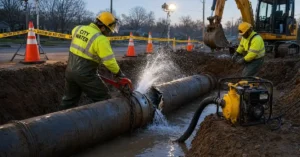
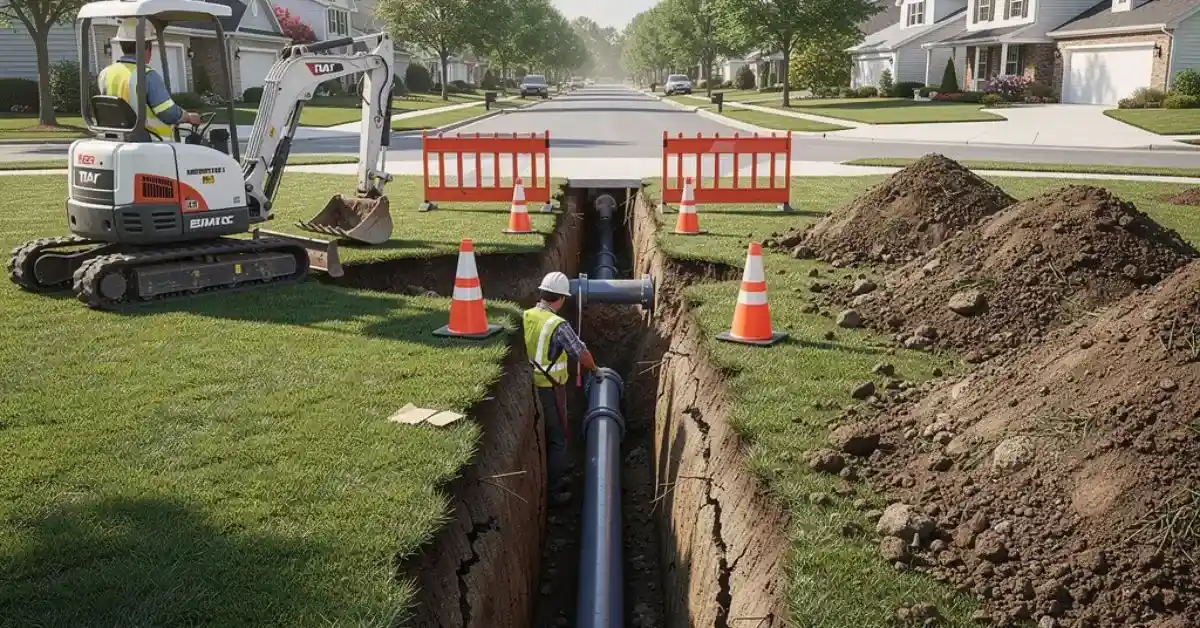
This is the oldest and most straightforward method. A trench is dug along the full length of the damaged pipe, the old pipe is removed, and new pipe is installed in its place.
It is the most disruptive method because it requires digging up landscaping, driveways, sidewalks, or other surface features above the pipe. However, it is also the most reliable because the plumber can see exactly what they are working with and address any complicating factors directly.
Traditional excavation is still the best option when the pipe has fully collapsed, when the soil conditions make trenchless methods difficult, or when the line needs significant re-routing.
Cost range: $50 to $200 per linear foot, with total projects typically running $3,000 to $15,000 depending on length and surface restoration requirements.
Pipe Bursting
This is a trenchless method that replaces old pipe without digging a full trench. A bursting head is pulled through the existing pipe, fracturing it outward into the surrounding soil while simultaneously pulling a new pipe into position behind it.
It requires only two small access points, one at each end of the replacement section, rather than a full trench. This preserves most landscaping and hardscaping and significantly reduces labor time.
Pipe bursting works well when the existing pipe, despite being damaged, still provides a usable pathway for the equipment. It does not work when the pipe has fully collapsed or when there are significant bends or obstructions in the line.
Cost range: $60 to $200 per linear foot, total projects typically $4,000 to $20,000.
Pipe Lining (CIPP)
Cured-in-place pipe lining, commonly called CIPP, involves inserting a flexible liner coated with resin into the existing pipe. The liner is inflated and the resin is cured using heat or UV light, creating a smooth new pipe wall inside the old one.
This method is the least disruptive of all options. No digging is required beyond access points. The new lining seals cracks, covers gaps, and eliminates root entry points while restoring full flow capacity.
The limitation is that it slightly reduces the internal diameter of the pipe and cannot be used when the pipe has collapsed completely or is severely misaligned.
Cost range: $80 to $250 per linear foot, total projects typically $4,000 to $25,000.
Repair vs. Full Replacement: Making the Right Call
Not every sewer line problem requires full replacement. Understanding when repair is appropriate saves money without sacrificing reliability.
Repair is appropriate when:
- The damage is isolated to a small section of otherwise healthy pipe
- A single joint has separated or a short section has cracked
- Root intrusion has occurred but the pipe structure is still intact
- The pipe material is modern PVC in otherwise good condition
Full replacement is the better choice when:
- The pipe material is clay, Orangeburg, or severely corroded cast iron
- Root intrusion has caused damage along multiple sections
- Camera inspection reveals widespread cracking, collapse, or misalignment
- The same section has been repaired multiple times and problems keep returning
- The pipe is more than 40 years old with no documented condition assessment
A spot repair on a 60-year-old clay pipe is often like patching one spot on a failing tire. The underlying material condition means another failure point will emerge elsewhere within a short time.
Realistic Costs for Sewer Line Replacement in the US
| Method | Cost Per Linear Foot | Typical Total Cost | Disruption Level |
|---|---|---|---|
| Traditional Excavation | $50 to $200 | $3,000 to $15,000 | High |
| Pipe Bursting | $60 to $200 | $4,000 to $20,000 | Low to moderate |
| Pipe Lining (CIPP) | $80 to $250 | $4,000 to $25,000 | Very low |
| Spot Repair | $500 to $3,000 flat | $500 to $3,000 | Low |
These ranges reflect typical US market pricing. Final costs vary based on local labor rates, pipe depth, soil conditions, permit requirements, and whether surface restoration like driveway or sidewalk replacement is needed.
Always get a minimum of three written quotes from licensed plumbers before committing to any replacement project.
What to Expect During the Process
A responsible plumber will begin with a sewer camera inspection before recommending replacement. This involves running a waterproof camera through the line via a cleanout access point to visually assess pipe condition. You should be able to watch the footage with them and understand what they are seeing.
The camera inspection typically costs $150 to $400 and provides a clear basis for the replacement recommendation. Be cautious of any contractor who recommends full replacement without conducting or showing you camera footage first.
Once replacement is approved, permits are typically required. A reputable plumber will pull the necessary permits, which ensures the work is inspected by the local building department and meets code requirements. Unpermitted sewer work can create problems when selling the home.
The work itself takes one to three days for most residential projects depending on method and length. Traditional excavation with surface restoration can take longer.
Conclusion
Sewer line replacement sounds intimidating, but it is a well-established process with clear methods, predictable timelines, and realistic cost ranges once you understand what is involved. The key is acting on warning signs promptly rather than hoping problems resolve themselves, and getting a proper camera inspection before agreeing to any scope of work.
Modern trenchless methods have made the process significantly less disruptive than it was even fifteen years ago. And a properly installed new sewer line, whether PVC pipe or a cured lining, will likely outlast your time in the home by decades.
The most important steps are getting camera evidence of the actual problem, collecting multiple quotes, confirming that permits are being pulled, and choosing a licensed contractor with documented experience in sewer replacement work.
Frequently Asked Questions
How do I know if my sewer line needs repair or replacement?
A sewer camera inspection can identify the pipe’s condition. Minor damage usually needs repair, while severe or repeated issues often require replacement.
How much does sewer line replacement cost?
In the US, costs typically range from $3,000 to $25,000, depending on the pipe length, depth, and replacement method.
What is trenchless sewer line replacement?
Trenchless replacement repairs or replaces pipes with minimal digging, making it faster and less disruptive than traditional excavation.
How long does a new sewer line last?
PVC sewer pipes can last 50–100 years, while CIPP pipe lining is expected to last 50+ years with proper maintenance.
Does homeowners insurance cover sewer line replacement?
Usually not. Most policies exclude damage from aging or tree roots, though some offer optional service line coverage.
Can I replace a sewer line myself?
No. Sewer line replacement requires specialized equipment, permits, and professional expertise, so hiring a licensed plumber is recommended.