
Introduction
A dripping faucet keeping you up at night. A toilet that keeps running after you flush. A showerhead with water pressure so weak it barely rinses shampoo out of your hair.
These are the kinds of plumbing problems most homeowners just live with — either because they assume it’s complicated, or because they don’t want to pay a plumber for something that might be simple.
Here’s the truth: a lot of common plumbing problems are genuinely fixable without professional help. You don’t need a license or years of experience. You need the right information, the right tools, and a clear understanding of where the limits are.
This guide covers the most practical DIY plumbing fixes homeowners can handle safely — with honest guidance on what to do, how to do it, and when to put the wrench down and make a call.
What Are DIY Plumbing Fixes?
DIY plumbing fixes are repairs and maintenance tasks that homeowners can safely complete themselves without hiring a licensed plumber. They typically involve replacing worn parts, clearing blockages, or adjusting simple components in faucets, toilets, drains, and supply lines. These fixes require basic tools, a little patience, and the confidence to follow clear instructions — not professional training.
Quick Summary
You can fix dripping faucets, running toilets, slow drains, low-pressure showerheads, and leaking supply lines yourself. Know your limits, use the right tools, and call a plumber for anything involving main lines, gas, or permits.
What You’ll Need Before You Start
Before touching any plumbing, there are a few basics that apply to every repair.
Know where your shut-off valves are.
Every sink, toilet, and appliance has its own shut-off valve nearby. Your home also has a main shut-off valve — usually near the water meter, in the basement, or outside. Know both locations before you start any repair.
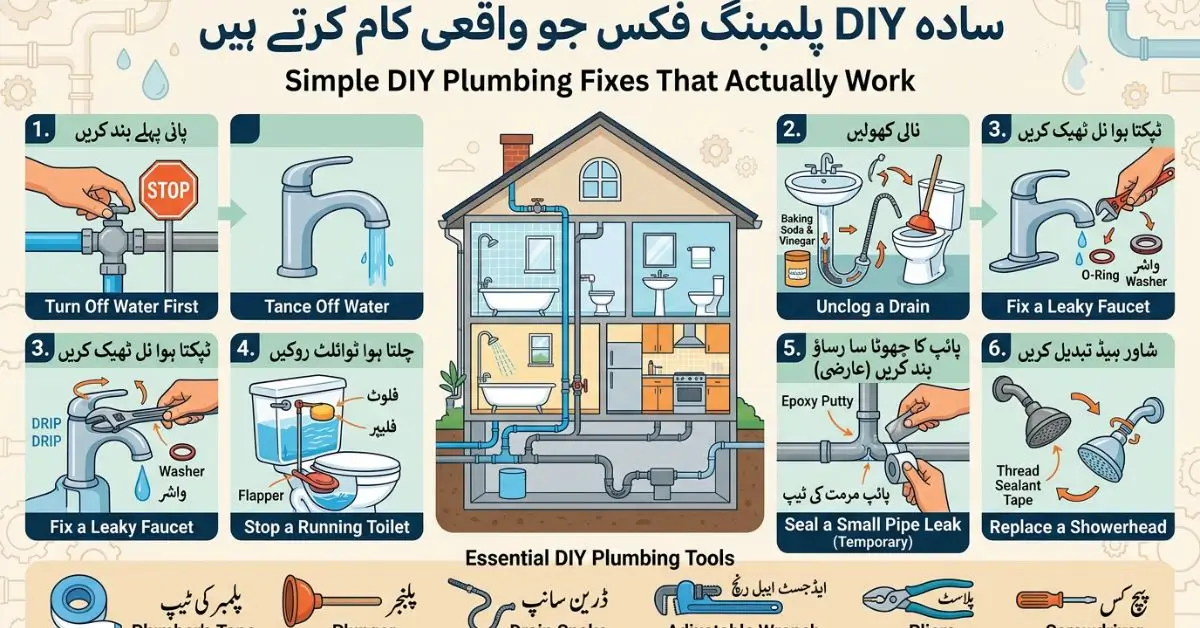
Basic tools for most DIY plumbing repairs:
- Adjustable wrench and basin wrench
- Pliers (slip-joint and needle-nose)
- Plunger (cup-style for sinks, flange-style for toilets)
- Plumber’s tape (Teflon tape)
- Replacement washers, O-rings, and flappers
- Bucket and old towels
Most of these cost under $50 total if you don’t already have them. That’s less than a single plumber call-out fee in most US cities.
Fix 1: A Dripping Faucet
A faucet that drips once per second wastes over 3,000 gallons of water per year, according to the EPA. It’s also one of the easiest DIY plumbing fixes to complete.
What causes it:
Most dripping faucets are caused by a worn washer, O-ring, or cartridge inside the faucet handle. Every time you turn the tap off, that small rubber piece compresses against a seat. Over time, it wears down and stops sealing properly.
How to fix it:
- Turn off the water supply valve under the sink
- Remove the faucet handle — usually held by a small screw under a decorative cap
- Locate the washer or cartridge inside (depends on faucet type)
- Take the old part to a hardware store and match it exactly
- Install the new part, reassemble the handle, and turn the water back on
- Test for dripping
Replacement parts usually cost $2–$10. The whole repair takes 20–40 minutes for a first-timer.
When to stop: If the faucet body itself is cracked or corroded, or if it’s an unusual valve type you don’t recognize, call a plumber rather than guess.
Fix 2: A Running Toilet
A toilet that keeps running after flushing can waste up to 200 gallons of water per day. That adds up fast on your water bill.
What causes it:
Usually one of three things — a worn flapper, a float set too high, or a faulty fill valve.
How to diagnose it:
Take the lid off the tank and look inside. If water is running into the overflow tube (the tall tube in the center), the float is set too high. If water is leaking through the flapper into the bowl, the flapper needs replacing.
Flapper replacement (most common fix):
- Turn off the toilet shut-off valve
- Flush to empty the tank
- Unhook the old flapper from the two pegs on the overflow tube
- Disconnect the chain from the flush handle arm
- Attach the new flapper and reconnect the chain — leave a small amount of slack
- Turn the water back on and test
A replacement flapper costs around $5–$10 and takes less than 15 minutes to install. It’s one of the most satisfying and cost-effective plumbing repairs you can do yourself.
Float adjustment:
If the float is the issue, bend the float arm slightly downward (on older ball-float systems) or adjust the adjustment screw on newer fill valves until the water stops before reaching the overflow tube.
Fix 3: A Slow or Clogged Drain
Slow drains are frustrating but rarely mysterious. Hair, soap scum, grease, and food debris are almost always the cause.
Kitchen sink:
Start with boiling water poured slowly down the drain. If that doesn’t work, try the baking soda and vinegar method — half a cup of each, let it fizz for 15 minutes, then flush with hot water. For a real clog, use a drain snake (also called a hand auger) to physically pull out the blockage.
Bathroom sink or tub:
Hair is usually the culprit. Most bathroom sink clogs are right at the pop-up drain stopper — you can often pull the stopper out by hand or with a screwdriver and remove a clump of hair directly. For tub drains, a drain snake works well.
What not to do:
Avoid pouring chemical drain cleaners regularly. They work short-term but can corrode older pipes with repeated use, especially if you have metal drain lines. Use them sparingly, if at all.
When to call a plumber:
If multiple drains in your home are slow at the same time, that’s not a clog — that’s a main sewer line issue. Don’t try to fix that yourself.
Fix 4: Low Water Pressure at a Faucet or Shower
If just one fixture has low pressure, the fix is usually simple. If every fixture in your home has low pressure, it’s a bigger issue worth calling a plumber for.
For a single faucet:
The aerator — the small mesh screen at the tip of the faucet — collects mineral deposits over time, especially in hard water areas. Unscrew it by hand or with pliers, soak it in white vinegar for 30 minutes, rinse it clean, and reattach it. Pressure usually returns immediately.
For a showerhead:
Same fix. Unscrew the showerhead, soak it in a bag of white vinegar for a few hours (or overnight), and reinstall it. If it’s badly clogged or old, a new showerhead costs $20–$60 and takes 10 minutes to install.
Plumber’s tape tip:
Whenever you remove and reattach a threaded connection — like a showerhead — wrap the threads with Teflon tape before reattaching. It seals the connection and prevents leaks.
Fix 5: A Leaking Supply Line
Supply lines are the flexible hoses that connect your water shut-off valves to your toilet tank, faucets, and appliances. They’re one of the most common sources of under-sink leaks.
What causes it:
The fittings loosen over time, or the line itself cracks or deteriorates — especially the older braided plastic ones. Stainless steel braided lines are more durable and worth upgrading to.
How to fix it:
- Turn off the shut-off valve under the sink or behind the toilet
- Put a bucket under the connection to catch residual water
- Unscrew the old supply line by hand (or with pliers if it’s tight)
- Wrap the threads on the valve fitting with Teflon tape
- Attach the new supply line — hand-tight, then a quarter turn with pliers
- Turn the water back on and check for drips
Replacement supply lines cost $5–$15. This is one of the simplest and most impactful plumbing repairs a homeowner can make.
Fix 6: A Toilet That Won’t Flush Properly
If your toilet flushes weakly or incompletely, the problem is usually one of two things — a clog or a chain that’s too long.
Partial clog:
Use a flange plunger (the one with the rubber flap at the bottom). Position it over the drain hole, press down firmly to seal it, and push and pull with steady force. Don’t splash — slow, deliberate strokes work better than aggressive ones.
Chain length:
If the flush handle feels fine but the toilet doesn’t flush fully, the chain connecting the handle to the flapper might be too long, preventing the flapper from lifting all the way. Shorten the chain by hooking it to a higher link. Leave just a small amount of slack.
DIY vs. Call a Plumber: Quick Reference
| Problem | DIY Fix? | Call a Plumber If… |
|---|---|---|
| Dripping faucet | Yes | Faucet body is cracked or corroded |
| Running toilet | Yes | Fill valve replacement doesn’t help |
| Single clogged drain | Yes | Multiple drains are slow at once |
| Low pressure at one fixture | Yes | Pressure is low throughout the home |
| Leaking supply line | Yes | Leak is at the wall valve itself |
| Weak toilet flush | Yes | Problem persists after plunging |
| Burst pipe | No | Always |
| Sewer line blockage | No | Always |
| Water heater repair | No | Always |
| Gas line issues | No | Always |
The Golden Rule of DIY Plumbing
Know when to stop.
The line between a smart DIY repair and an expensive mistake is usually clear: if you’re unsure what you’re looking at, if the problem involves gas lines, main supply or sewer lines, or if the repair requires a permit — call a licensed plumber.
A good DIY repair saves you money and builds real confidence. A bad one can cause water damage, void your home insurance, or create code violations that cost more to fix than the original problem.
Most homeowners who learn a few solid DIY plumbing fixes find they can handle 70–80% of common household plumbing issues themselves. The remaining 20% is what plumbers are for.
Conclusion
Most common plumbing problems don’t need a professional — they need a homeowner who knows what to look for and isn’t afraid to try. DIY plumbing fixes like replacing a flapper, cleaning an aerator, or swapping out a supply line are genuinely straightforward once you’ve done them once.
Start with something small. Build confidence. Keep your tools handy and your shut-off valve locations memorized. And when something is beyond the scope of what you’re comfortable with, call a plumber without hesitation — that’s not a failure, that’s good judgment.
Frequently Asked Questions
What are the easiest DIY plumbing fixes for beginners?
Replacing a toilet flapper, cleaning a faucet aerator, and fixing a leaking supply line. All three require basic tools, cost very little, and take under 30 minutes to complete.
How do I fix a dripping faucet myself?
Turn off the supply valve, remove the handle, and replace the worn washer or cartridge. Match the old part at a hardware store first. Total cost is usually under $10 and takes less than an hour.
Can I fix a clogged drain without a plumber?
Yes, for most single-drain clogs. Try boiling water, baking soda and vinegar, or a drain snake. If multiple drains are slow at once, that’s a sewer line issue — call a plumber.
What tools do I need for basic plumbing repairs?
An adjustable wrench, slip-joint pliers, a plunger, Teflon tape, and a drain snake. A basic toolkit costs under $50 and covers most common household repairs.
When should I stop DIYing and call a plumber?
When the problem involves your main water line, sewer line, gas connections, a burst pipe, or anything requiring a permit. Also call if a repair you’ve tried isn’t working and you’re unsure why.
Is it safe to do plumbing repairs yourself?
Yes, for minor repairs like replacing washers, flappers, and aerators. Avoid anything involving gas lines, main shutoffs, or structural pipe changes — those need a licensed professional.